
Bull Markets That Last Four Years Typically Last Five
October 14, 2026 | Jeff Buchbinder
Happy Anniversary bull market! October 12 marked the fourth anniversary of the bull market that began at the S&P 500’s closing low of 3,577 on October 12, 2022. Four years later, the index has more than doubled, an impressive run considering everything investors have endured along the way. The gain in the first four years on a price basis was 118%.
When we celebrated this bull market’s third birthday a year ago, we noted that history suggested the advance probably had more room to run. Well, history delivered. In the year ending October 12, 2026, the S&P 500 gained an impressive 19.2%.
That resilience is notable considering the formidable wall of worry markets have climbed. Investors have worked through monetary tightening, tariff uncertainty, geopolitical conflicts, an oil-price shock, higher Treasury yields, and persistent questions about whether enthusiasm surrounding artificial intelligence (AI) has gone too far. Despite those challenges, the S&P 500 recently traded near record highs.
The fundamental backdrop has helped. Corporate profits remain strong, while the AI infrastructure buildout continues to support spending on semiconductors, memory, data centers, power, and related equipment.
So, what does history tell us about the four-year-old bull market’s chances at making it to five?
Alive at Five! Four-Year-Old Bull Markets Have Historically Continued Another Year
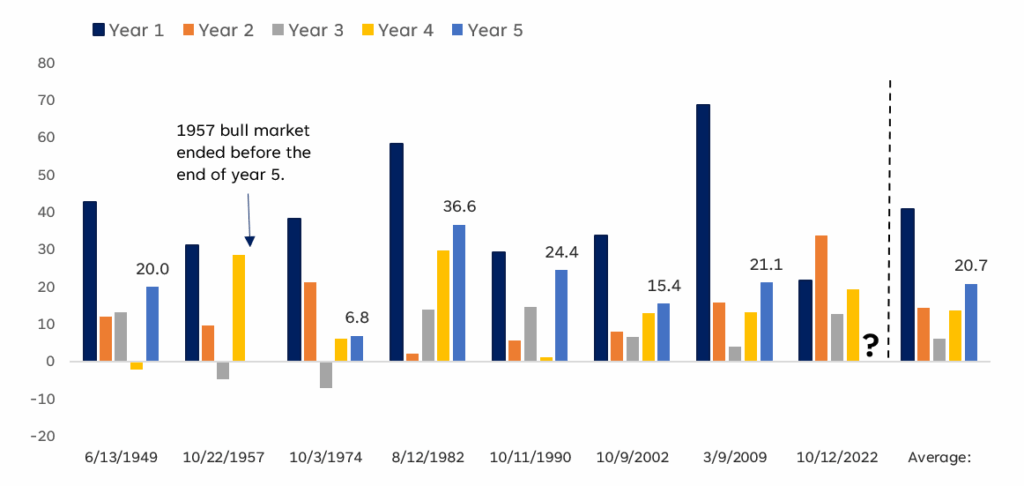
Source: LPL Research, Bloomberg, 10/13/26
Disclosures: Past performance is no guarantee of future results. All indexes are unmanaged and cannot be invested in directly.
Note: Only S&P 500 bull markets that made it through a fourth year are shown, including the current bull market.
As shown in the “Alive at Five! Four-Year-Old Bull Markets Have Historically Continued Another Year” chart, history offers a positive signal. Looking at the bull markets in the accompanying chart that survived five full years, the average S&P 500 gain during year five was 20.7%. Results varied quite a bit, but year five was positive in each instance. Particularly strong fifth years came in the 1982 and 1990 bull markets, with gains of 36.6% and 24.4%, respectively, while the 1974 bull produced a more modest 6.8% gain in its fifth year. Past performance does not guarantee future results.
The one exception is the 1957 bull market that made it to year four but did not last five (five out of six isn’t bad). Several factors contributed to the end of that bull market in 1961, including President Kennedy’s strained relationship with the corporate sector, particularly U.S. Steel. Elevated valuations and waning investor confidence have also been cited as contributing factors, making this selloff unusual in that recession, tightening monetary policy, or a financial crisis were not causes.
Looking ahead, of course we would happily take anything close to another 20% gain over the next 12 months, which is possible, but we certainly would not predict it. We would say this. If rates and oil come down meaningfully and AI delivers on its promise, the next 12 months may be very rewarding for investors.
The most important takeaway from this analysis is that bull markets don’t typically die of old age. Something kills them — typically a recession or financial crisis, neither of which seem likely in the coming year. With capital investment in AI infrastructure set to increase in 2027 and expected to drive another year of strong earnings growth, and consumers maintaining spending on the back of a very positive wealth effect and limited interest rate sensitivity, a recession is probably not in the cards for 2027. That bodes well for this bull market in its quest to celebrate its fifth anniversary one year from now.
Important Disclosures
This material is for general information only and is not intended to provide specific advice or recommendations for any individual. There is no assurance that the views or strategies discussed are suitable for all investors. To determine which investment(s) may be appropriate for you, please consult your financial professional prior to investing.
Investing involves risks including possible loss of principal. No investment strategy or risk management technique can guarantee return or eliminate risk.
Indexes are unmanaged and cannot be invested into directly. Index performance is not indicative of the performance of any investment and does not reflect fees, expenses, or sales charges. All performance referenced is historical and is no guarantee of future results.
This material was prepared by LPL Financial, LLC. All information is believed to be from reliable sources; however LPL Financial makes no representation as to its completeness or accuracy.
Unless otherwise stated LPL Financial and the third party persons and firms mentioned are not affiliates of each other and make no representation with respect to each other. Any company names noted herein are for educational purposes only and not an indication of trading intent or a solicitation of their products or services.
Asset Class Disclosures –
International investing involves special risks such as currency fluctuation and political instability and may not be suitable for all investors. These risks are often heightened for investments in emerging markets.
Bonds are subject to market and interest rate risk if sold prior to maturity.
Municipal bonds are subject and market and interest rate risk and potentially capital gains tax if sold prior to maturity. Interest income may be subject to the alternative minimum tax. Municipal bonds are federally tax-free but other state and local taxes may apply.
Preferred stock dividends are paid at the discretion of the issuing company. Preferred stocks are subject to interest rate and credit risk. They may be subject to a call features.
Alternative investments may not be suitable for all investors and involve special risks such as leveraging the investment, potential adverse market forces, regulatory changes and potentially illiquidity. The strategies employed in the management of alternative investments may accelerate the velocity of potential losses.
Mortgage backed securities are subject to credit, default, prepayment, extension, market and interest rate risk.
High yield/junk bonds (grade BB or below) are below investment grade securities, and are subject to higher interest rate, credit, and liquidity risks than those graded BBB and above. They generally should be part of a diversified portfolio for sophisticated investors.
Precious metal investing involves greater fluctuation and potential for losses.
The fast price swings of commodities will result in significant volatility in an investor’s holdings.
This research material has been prepared by LPL Financial LLC.
Not Insured by FDIC/NCUA or Any Other Government Agency | Not Bank/Credit Union Deposits or Obligations | Not Bank/Credit Union Guaranteed | May Lose Value
For Public Use – Tracking: #1191286